

NEW: Spring 2026 Book Tour Announced
See upcoming events in San Francisco, London, Paris, Geneva, and Asheville →
Regenerative Economics: Revolutionary Thinking for a World in Crisis
A new book by John Fullerton. Now available from your favorite bookseller, and in Europe January 8.
Regenerative Economics is based on the deceptively simple idea that an economic system should emulate the process and patterns that define all life. This science-based next evolution of economics explains the root cause of the polycrisis and promises a hopeful pathway forward, rooted in unseen potential and abundance.

SPRING 2026 BOOK TOUR
Meet John Fullerton on the road.
See John speak about Regenerative Economics around the world!
This spring, John will be speaking with investors, economists, students, and changemakers about the ideas behind Regenerative Economics, a framework for redesigning our economic system to align with the patterns of living systems.
Each event brings together local leaders and communities to explore how regenerative thinking can reshape finance, policy, and business for a thriving future.
If you are near one of these cities, you are warmly invited. Find details and registration links below.
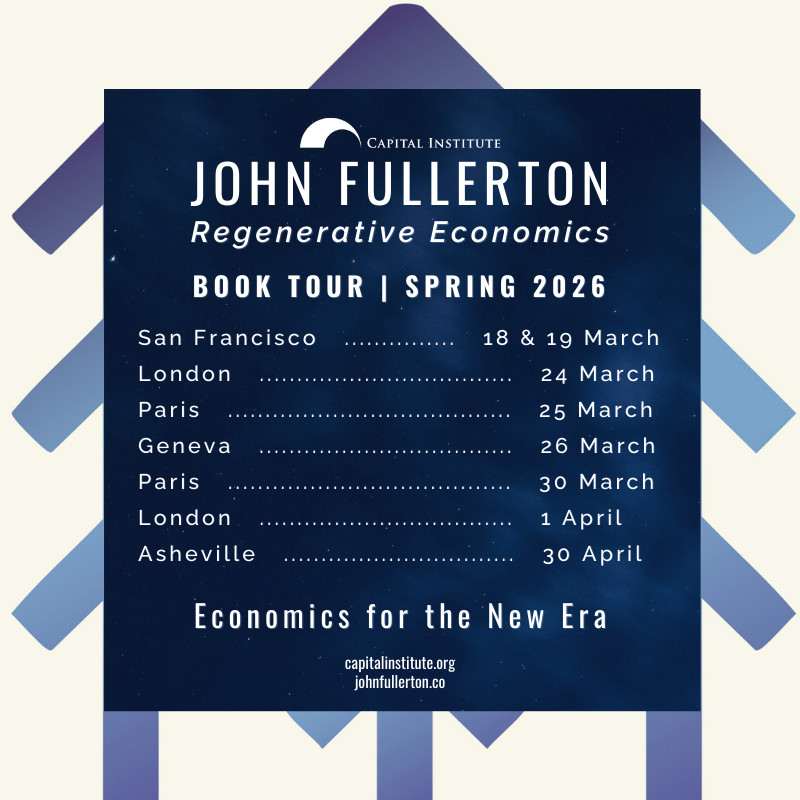
A number of stops on the tour are still open for public registration:
United States
- San Francisco — Good People Dinner 195 at Arion Press | March 18, 6:00 PM
- San Francisco — Global Philanthropy Forum at the 2026 Leaders Summit | March 19
Europe
- London — Ladbroke Hall | March 24, 7:00 PM
→ Register here. - Geneva — The Plaza | March 26, 5:00 PM
→ Register here. - Paris — Climate House | March 30, 6:00 PM
→ Register here. - London — The Conduit | April 1, 6:00 PM
→ Register here.
United States
- Asheville — With Life Asheville Retreat | May 1, 9:00 AM
The tour will conclude this spring in Asheville, North Carolina, where John will join us for the With Life Asheville Retreat (April 30–May 3) to lead
a full day exploring Re|Imagining Economics and Finance in Service to Life. → Register here.
This is economics for the new era. Join the conversation.
About The Book
A bold vision of an economy as an intelligent living organism, freed from the mindless finance algorithm, unlocking unseen potential
Regenerative Economics is based on the deceptively simple idea that an economic system should emulate the process and patterns that define all life, enabling it to adapt and evolve to higher levels of complexity. This science-based next evolution of economics explains the root cause of the polycrisis–the compounding impacts of climate change, ecosystem and biodiversity loss, planetary systems breakdown, and increasing social and economic inequity—and promises a hopeful pathway forward at this pivotable moment.
Rather than reacting to crisis after crisis, the purpose of a regenerative economy is to create the conditions that nurture and sustain health and all life.
This hard-hitting and scientifically rigorous yet ultimately hopeful book:
- Identifies the unseen fatal error of our current economic model
- Outlines a set of key regenerative design principles to navigate the polycrisis
- Prescribes transformative individual actions and policies which both embrace and move beyond current materialist ideas of sustainability, circularity, and degrowth, to redefine systemic health and true value within the context of a whole-living-systems approach
- Offers a fresh pathway through the polycrisis and toward a new economy—one that prioritizes human and planetary well-being, operates within ecological limits, and promotes a more just and sustainable future.
This seminal work is required reading for business, government, and community leaders; economic thinkers; academics; and anyone who questions the future of capitalism given the reality of finite planetary boundaries and growing social injustice.
About The Author
John Fullerton is an unconventional economist, impact investor, author, and some say philosopher. Following a two-decade successful career at JPMorgan, he walked away in 2001 with no plan but many questions. Now considered the architect of Regenerative Economics, he founded The Capital Institute in 2010 to explore the urgent need for economics and finance in service to life. John lives in Stonington, CT.